This article was inspired by a podcast conversation between Dr Rangan Chatterjee and Dr Stacy Sims, an exercise physiologist and researcher whose work focuses on female physiology and performance. Dr Sims is someone a few of my female health-conscious friends from university are, frankly, obsessed with, so I was glad to finally sit down and listen properly.
This is the first article in a four-part series inspired by that conversation:
- Part 1: Why your body starts to change
- Part 2: Why strength matters more than ever
- Part 3: Is walking enough?
- Part 4: Why eating less often isn’t the answer
I like podcasts that make me question things I’ve taken for granted for years, and this one did exactly that.
Around two-thirds of the people we see in clinic are women, a good number of them in their late 30s, 40s, 50s and 60s. We hear comments like these fairly regularly:
“I’m exercising just as much as I always have, but my body seems to be changing.”
“I’m putting weight on around my middle, even though nothing’s really changed.”
“I feel tired all the time, but I can’t switch off.”
“I hear that women my age need to do weight training.”
If any of that sounds familiar, you’re in good company.
What struck me listening to Dr Sims was just how extensive the changes during perimenopause can be, and how little most of us understand about what’s actually going on inside the body while it happens.
It’s more than menopause
Most people hear “menopause” and think of hot flushes and periods stopping. But the transition usually starts years earlier, during perimenopause, when hormone levels begin fluctuating well before menopause itself arrives. For some women that can start in their late 30s or early 40s, though the timing varies a lot from person to person.
It’s not simply a steady decline in oestrogen, either. As ovarian function starts to change, ovulation becomes less predictable and both oestrogen and progesterone can swing considerably before eventually settling at much lower levels after menopause.
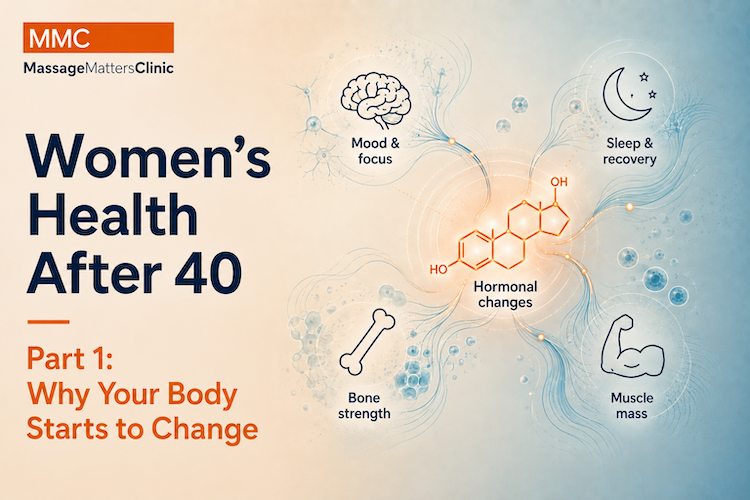
That matters because these hormones aren’t only involved in reproduction — they interact with tissues throughout the body, including muscle, bone, blood vessels and the brain. So when the hormonal environment shifts, the knock-on effects can turn up in some fairly unexpected places.
Muscle and strength
Oestrogen plays a part in keeping skeletal muscle healthy and functioning well. We naturally become more prone to losing muscle mass and strength as we age, and the hormonal changes around menopause can add to that — sometimes showing up as a drop in strength and power before there’s any obvious loss of muscle itself.
That’s worth paying attention to, because muscle isn’t just about appearance or athletic performance. It helps regulate blood glucose, supports the joints, and keeps us physically capable and independent as we get older. We’ll go into this in more depth, including why resistance training becomes so important, in Part 2.
Bones
Bone is constantly being broken down and rebuilt, and oestrogen helps regulate that process. As oestrogen declines around menopause, bone can start being broken down faster than the body replaces it, which accelerates bone density loss. That’s part of why the years around menopause matter so much for long-term bone health, and why osteoporosis, despite being associated with much older women, is worth thinking about earlier than people tend to assume.
Metabolism and body composition
Many women notice fat starting to settle in a different place. During and after menopause, fat distribution can shift away from the hips and thighs and towards the abdomen, including more visceral fat around the internal organs, and insulin sensitivity can change too, making blood sugar regulation trickier. Hormones seem to play a part in this shift, alongside sleep, stress and cortisol. It’s not just about eating too much or moving too little. Ageing, activity levels, sleep, diet and genetics all play a part here as well, so it’s not fair to pin everything on hormones — but the menopausal transition does seem to have an influence of its own.
Heart and blood vessels
Oestrogen interacts with the cardiovascular system too, and as women move through menopause, changes can show up in cholesterol, blood pressure and how flexible blood vessels are. Cardiovascular disease becomes an increasingly important part of women’s health as they age, which is another reason to think about menopause as more than just a reproductive event.
Brain, sleep and the nervous system
Fluctuating hormones can also affect temperature regulation, mood and sleep, which goes some way to explaining hot flushes, night sweats, disrupted sleep and that particular kind of exhaustion where you’re tired but can’t properly switch off. Changes in oestrogen and progesterone can also interact with the body’s stress-response systems. For some women, this may make it harder to move out of that alert, “tired but wired” state, particularly when poor sleep and everyday stress are added into the mix. Cortisol — one of our main stress hormones — is part of this picture, although the relationship between menopause and cortisol is more complicated than simply saying that falling oestrogen causes cortisol to rise. None of this stays neatly separated, either — poor sleep hits recovery, recovery affects how much energy you have for activity, and low activity and disrupted sleep both feed back into appetite and metabolic health. It’s a good reminder that the body doesn’t work as a set of independent parts.
Why the old approach stops working
One of the things that came through clearly in the podcast was how many women keep doing what’s always worked for them: eating a bit less to lose weight, plenty of cardio, pushing through the tiredness. It’s a reasonable instinct, since it worked before. The problem is that it’s now being asked of a body operating in a very different hormonal environment to the one it was in ten or twenty years ago.
That doesn’t mean everything breaks down at 40, or that menopause automatically leads to weight gain, weakness or poor health. It just means the body’s needs are shifting too, and that’s actually the useful part of all this: a lot of what protects muscle, bone, metabolic health and physical independence through this stage is well within our control.
The reassuring bit
Here’s what I took as the most reassuring part of the conversation: these changes have a biological explanation, and understanding what’s driving them gives you more to work with, not less. They don’t mean you’re stuck accepting less energy, less strength or less capability as you get older. They’re more a sign that it’s time to adjust how you look after yourself.
Over the next few articles, we’ll get into the practical side of this, drawing on what Dr Sims discussed and the wider research: why strength training matters more after 40, whether walking alone is enough, where higher-intensity exercise fits in, and why nutrition at this stage of life often isn’t as simple as eating less.
For now, if your body feels different to how it did ten or twenty years ago, this is at least part of why, and there’s plenty you can still do about it.
In Part 2, we’ll look at one of the most important things you can do to protect your health as you get older: getting stronger.
Further reading and listening
This article was inspired by a conversation between Dr Rangan Chatterjee and Dr Stacy Sims, alongside current research on women’s health, exercise and healthy ageing. It isn’t meant to reproduce that conversation, and I’d certainly recommend listening to the full episode if you want to go deeper.
As always, this is general information rather than personalised medical advice. Every woman’s experience of perimenopause and menopause is different. If you’re concerned about your health, dealing with symptoms that are affecting your day-to-day life, or thinking about making significant changes to your exercise or nutrition, please speak to your GP or another appropriately qualified healthcare professional.