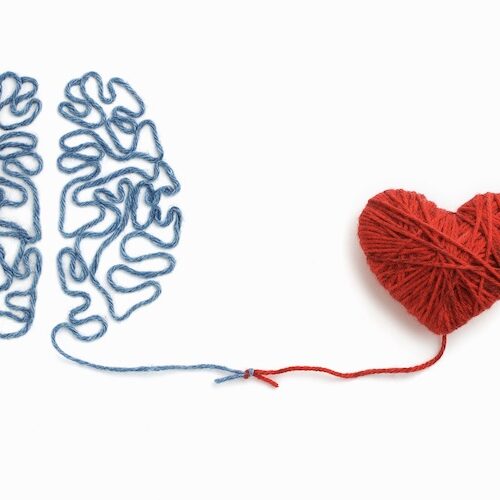
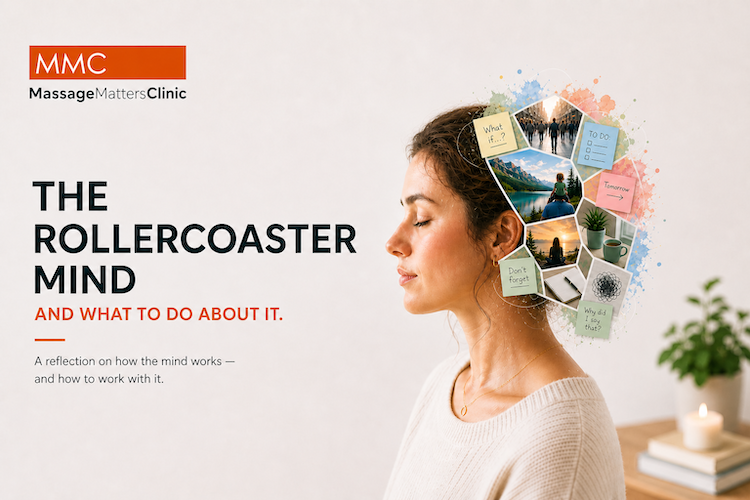
One of the conversations I find myself having most regularly with people — often on the couch, mid-treatment — is about the mind. About how busy it is. The whirling torrent of ceaseless thoughts that most people quietly assume only they experience.
Here’s the thing: you’re not alone in this. Just as people often assume they’re uniquely lazy for not doing their stretches (most people don’t, and as humans we’re somewhat hardwired for the path of least resistance), people also assume they’re uniquely challenged by a mind that never seems to settle. There’s always another thing to think about — a worry about the future, a memory from the past, a “what if” concern, plans, regrets, wondering what other people think of us, or whether they think of us at all.
This, it turns out, is the normal functioning of the mind. So much so that neuroscientists have a name for the brain regions responsible for exactly this kind of activity — daydreaming, remembering, planning, self-reflection, imagining other people’s thoughts. They call it the Default Mode Network: the idea being that when the brain isn’t otherwise engaged, it automatically defaults to these kinds of thoughts.
I’ll be honest — I’m not entirely convinced this is truly a “default” for the human brain, rather than something shaped by how we’re brought up and taught to think. But that’s a conversation for another day.
Here’s what I find more interesting: if you pause and think about all those default activities — the past, the future, other people, ourselves, our daydreams — what do they all have in common? They’re all, in a sense, fiction. None of them actually exists in the real world right now. They exist only as temporary electrical impulses in the brain. Think about how much of each day, week, or year you spend in one of these states — and then consider how much of that time could have been spent actually engaging with the real, tangible experience of the present moment. To me, that’s quite a freeing thought.
This isn’t to say planning, reflection, or speculation are bad. Of course we need them. And there’s genuine value in allowing the mind to wander — neuroscientists have noted that unguided thought is important for problem-solving, processing difficult experiences, and generating creative ideas. This happens during sleep, but also in our waking hours.
The trouble is the lack of choice in the matter.
On a good day — if I’ve slept well, exercised, had some good news, or the biochemical stars have aligned in my favour (without me even knowing why) — the runaway train of the mind can be genuinely enjoyable. Thought flows into thought, and it feels energising. But here’s the problem: on a bad day, I’m still on the same rollercoaster. Only now there are far more downs than ups, and I didn’t choose to get on.
This is where meditation comes in — or whatever you want to call it. At its heart, it’s the art and practice of gently guiding the mind back to an experience in the here and now. Not suppression, not switching the mind off, but building — like training a muscle in the gym — more choice over when the default mode kicks in. The goal isn’t to stop the rollercoaster. It’s to decide when you get on and when you get off.
I should say: this isn’t something I recommend at a distance. This is a practice I’ve come back to repeatedly in my own life, and the difference it makes — particularly on the harder days — is significant. It’s probably as difficult as anything I’ve tried, in the way that learning a language or building real physical fitness is difficult. But when it clicks, it’s also surprisingly simple, and genuinely life-changing.
If it’s something you’re curious about, I’m always happy to chat — you know where to find me.