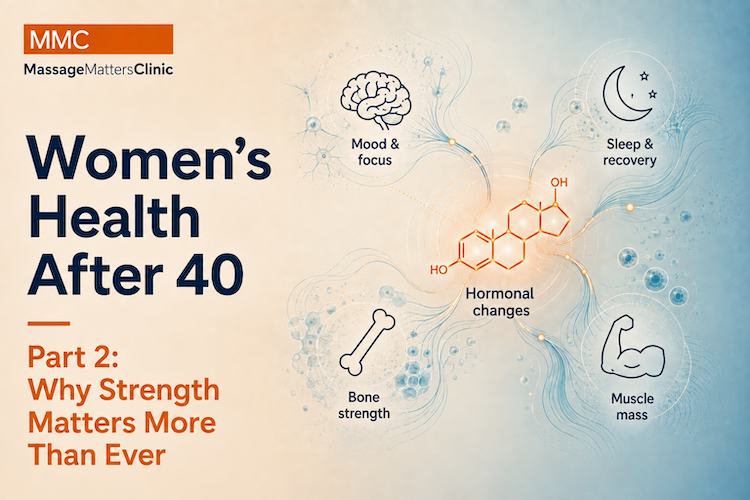
This is the second article in our Women’s Health After 40 series, inspired by a podcast conversation between Dr Rangan Chatterjee and Dr Stacy Sims, an exercise physiologist and researcher whose work focuses on female physiology and performance.
For years, most of the exercise advice aimed at women has been about becoming smaller — lose weight, burn calories, tone up. But as women move through their 40s, 50s and beyond, there’s a strong case for a different goal taking priority: getting stronger.
In Part 1, we looked at some of the changes taking place during perimenopause and menopause. One of the most important involves our muscles.
Muscle is about much more than appearance
Maintaining muscle mass and strength naturally gets harder as we age, and the changing hormonal environment around menopause can add to that. But muscle isn’t just about how you look. It’s what lets you lift, carry, climb stairs and get up off the floor. It supports your joints and balance, and plays a role in metabolic health, including how the body manages glucose. Perhaps most importantly, it’s what keeps you physically capable and independent as you get older.
That might not feel particularly urgent at 42 or 52 — but the strength you’ll need later in life doesn’t appear from nowhere when you need it. Building and maintaining it now gives you more in reserve.
What does strength training actually mean?
One of the more interesting parts of Dr Sims’ conversation was her take on how exercise has traditionally been marketed to women — light weights, lots of repetitions, the goal of becoming “toned” without becoming “bulky.” The trouble is there isn’t really a separate physiological process called toning. If you want muscle to stay strong, it needs a reason to adapt, and that reason is resistance — whether that comes from dumbbells, kettlebells, machines, resistance bands or your own bodyweight. What matters is that it’s genuinely challenging, and that the challenge increases gradually as you get stronger (known as progressive resistance training).
Dr Sims is a strong advocate for women lifting heavier rather than relying purely on light weights and high reps. That doesn’t mean walking into a gym and grabbing the heaviest dumbbell you can find — someone starting strength training at 50 has very different needs to someone who’s trained for twenty years. The aim is simply to challenge the muscles appropriately, and to keep doing so as they adapt.
It’s not just about muscle
There’s another good reason to think about strength around menopause: bone. Bone is living tissue, constantly being broken down and rebuilt, and as we covered in Part 1, declining oestrogen around menopause can accelerate bone density loss. Resistance training and other weight-bearing activity place mechanical stress through the bones, which sounds counterintuitive, but that loading is actually what signals bone to adapt and hold onto its strength.
It would be overstating things to say lifting weights guarantees protection against osteoporosis — bone health depends on a lot of factors — but resistance and weight-bearing exercise are a genuinely important part of looking after your bones as you get older.
You don’t need to become a powerlifter
The encouraging part is that it’s never too late to get stronger. Current UK guidance recommends strengthening the major muscle groups on at least two days a week. If you haven’t done resistance training before, that can mean starting with fairly simple movements and building up the resistance gradually as your strength and confidence improve. You don’t need to become a bodybuilder, and you don’t need to chase a number on a barbell — you just need to give your muscles a reason to stay strong.
It’s also worth a small shift in how you think about exercise. Rather than just asking how many calories a session burned, it’s worth occasionally asking what you’re doing today that helps your body stay capable in ten, twenty or thirty years’ time — strong enough to carry the shopping, lift a suitcase, get up off the floor without thinking about it, and keep doing the things you actually enjoy.
For women moving through their 40s, 50s and 60s, muscle isn’t something to be wary of. It’s something worth protecting.
In Part 3, we’ll look at another question Dr Sims raised: if you’re already active and walking regularly, is that enough?
Further reading and listening
This article was inspired by a podcast conversation between Dr Rangan Chatterjee and Dr Stacy Sims, alongside current research into resistance training, menopause, muscle and bone health. UK health guidance recommends muscle-strengthening activity on at least two days each week, alongside regular aerobic activity.
As always, this is general information rather than personalised medical or exercise advice. If you haven’t exercised for some time, have a medical condition, or have concerns about exercising safely, please speak to your GP, physiotherapist or an appropriately qualified exercise professional before starting a new programme.