
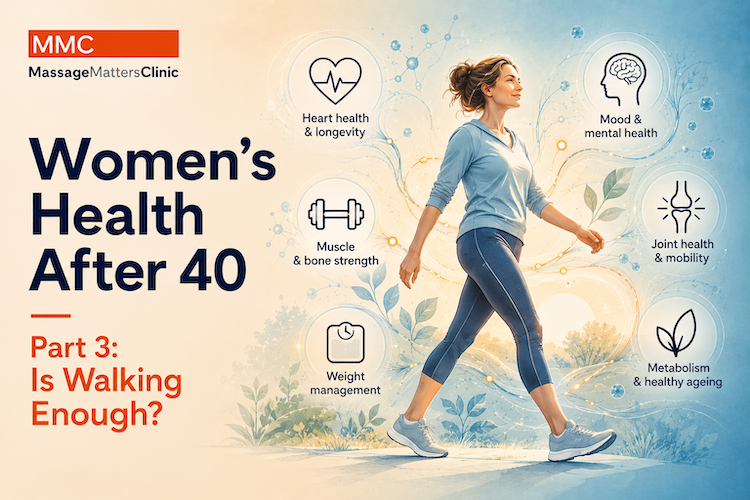
This is the third article in our Women’s Health After 40 series, inspired by a podcast conversation between Dr Rangan Chatterjee and Dr Stacy Sims, an exercise physiologist and researcher whose work focuses on female physiology and performance.
If there’s one principle I come back to again and again, in clinic and in my own life, it’s that variety generally wins when it comes to health, longevity and resilience. It seems to hold for how we move, for what we eat (a wide range of plants is good for the gut), and even for the brain, which tends to thrive on learning new things rather than repeating familiar ones. It comes up in conversation with clients constantly, so I was particularly interested when Dr Stacy Sims asked whether walking is enough for women approaching and moving through menopause.
Walking is one of the most underrated forms of exercise. It’s accessible, it costs nothing, it does wonders for our mental health, and it gives real benefits for cardiovascular fitness and general wellbeing. Dr Sims’ point isn’t that walking is bad, or that we should all be pushing ourselves harder. It’s that different types of exercise encourage different adaptations in the body, and those differences become more important as we get older.
Why walking is so good for us
Regular walking supports cardiovascular health, helps regulate blood sugar and can improve sleep and mental wellbeing. A brisk walk also counts towards the UK’s recommended 150 minutes of moderate-intensity activity each week.
There is a difference, though, between staying active and developing particular aspects of fitness. Walking at a comfortable pace on flat ground doesn’t necessarily challenge the muscles or the cardiovascular system in the way more demanding exercise does. That doesn’t make it any less valuable, only that it may not give us everything we need.
Why intensity matters
One of Dr Sims’ central arguments is that women approaching and moving through menopause can benefit from adding more challenging exercise to what they already do. We covered resistance training for muscle and bone in Part 2, but the heart and lungs matter too.
Cardiorespiratory fitness describes how well the heart, lungs and circulation deliver oxygen to the muscles during activity. It’s an important indicator of long-term health, and it can improve when we occasionally push the cardiovascular system beyond its usual demands.
That’s where high-intensity interval training (HIIT) comes in. Rather than holding the same pace throughout, HIIT alternates harder efforts with easier movement or rest. On an exercise bike, for example, you might cycle comfortably for a few minutes, push hard for a short interval, then ease off to recover before repeating. Dr Sims also talks about sprint interval training, which uses very short bursts of near-maximal effort followed by longer recovery periods. Both can improve cardiovascular fitness, although the right intensity and the benefits depend on the individual. High intensity is also relative: what feels hard to someone who exercises regularly will be very different from what feels hard to someone just starting out.
Does menopause change the picture?
As we saw in Part 1, the menopausal transition can influence body composition, metabolic health and cardiovascular function. Dr Sims argues that this makes it especially worthwhile to include exercise that gives the body a strong enough stimulus to adapt, and there’s research supporting the benefits of higher-intensity training for cardiovascular fitness in middle-aged and older women.
That doesn’t mean moderate exercise stops working during menopause, or that every woman needs to do HIIT. Different kinds of exercise offer different benefits, and a mix is usually more useful than relying on one type.
Finding the right balance
Exercise doesn’t have to mean constantly pushing harder. Recovery matters too, particularly when sleep is disrupted, stress is high or you’re already running on empty, and the aim isn’t to turn every walk into a workout or finish every session wiped out.
The UK guidelines suggest at least 150 minutes of moderate aerobic activity a week, or 75 minutes of vigorous activity, or a mix of the two, alongside muscle-strengthening exercise on at least two days. Walking can be an excellent foundation, especially if you’ve been inactive for a while. As we get older, though, it’s worth asking whether we’re also giving our muscles and cardiovascular system the occasional chance to adapt to something harder. That could be resistance training, cycling uphill, swimming at a more challenging pace or adding some structured intervals, and the exact choice matters less than finding something manageable and enjoyable enough to keep doing.
Ultimately, regular movement is the foundation, and it benefits almost every system in the body. But it’s also worth giving our bodies enough variety to stay capable as we age. It’s what I say to people in clinic and what I try to practise myself: variety generally wins.
In Part 4, we’ll look at another key point from Dr Sims’ conversation: why eating less isn’t always the answer, and how nutrition can support muscle, recovery and health during menopause.
Further reading and listening
This article was inspired by a podcast conversation between Dr Rangan Chatterjee and Dr Stacy Sims, alongside research into cardiovascular fitness, exercise intensity and women’s health during menopause.
The NHS physical activity guidelines have more detail on recommended levels of aerobic and muscle-strengthening exercise.
As always, this is general information rather than personalised medical or exercise advice. If you’re new to vigorous exercise or have a medical condition, please seek appropriate guidance before introducing more demanding activity.